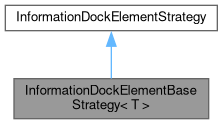
A generic InformationDockElementStrategy for specific TimedElements. More...
#include <InformationDockElementBaseStrategy.hpp>
Public Member Functions | |
| virtual T * | applicable (TimedElement *t) |
| Checks if the strategy is applicable for an element and returns the casted element if so. More... | |
| void | setup (QFormLayout *layout) override |
| Sets up the QFormLayout. More... | |
| virtual void | updateView (QFormLayout *layout, T *element) |
| Updates the view. More... | |
| bool | update (QFormLayout *layout, TimedElement *element) override |
| Sets up the QFormLayout. More... | |
| std::string | title () override |
| Returns the title the information dock should show. More... | |
| virtual void | setup (QFormLayout *) |
| Sets up the QFormLayout. More... | |
| virtual bool | update (QFormLayout *, TimedElement *) |
| Updates the view to show details about a newly selected element. More... | |
| virtual std::string | title () |
| Returns the title the information dock should show. More... | |
Static Public Member Functions | |
| static QString | tr (const char *s, const char *c=nullptr, int n=-1) |
Protected Attributes | |
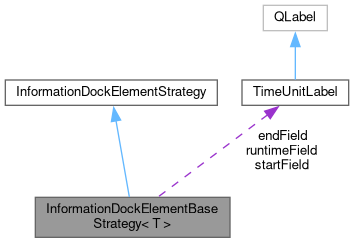
| TimeUnitLabel * | startField = nullptr |
| TimeUnitLabel * | endField = nullptr |
| TimeUnitLabel * | runtimeField = nullptr |
Detailed Description
requires std::is_base_of_v<TimedElement, T>
class InformationDockElementBaseStrategy< T >
A generic InformationDockElementStrategy for specific TimedElements.
This class abstracts a type check for selected elements. Derived classes can specify with the template parameter for which type of element they visualise information. Derived classes can overwrite the updateView function and get the selected element casted to their accepted type if it is of their accepted type.
- Template Parameters
-
T Type of TimedElement derived strategies accept
Definition at line 34 of file InformationDockElementBaseStrategy.hpp.
Member Function Documentation
◆ applicable()
|
inlinevirtual |
Checks if the strategy is applicable for an element and returns the casted element if so.
By default this function does a dynamic_cast to check whether the strategy is applicable to for the element. A derived class can overwrite this behaviour if there are other options to identify the runtime type.
- Parameters
-
t The newly selected element.
- Returns
- The selected element casted to T if the strategy accepts the element or nullptr if it does not
Definition at line 53 of file InformationDockElementBaseStrategy.hpp.
◆ setup()
requires std::is_base_of_v<TimedElement, T>
|
overridevirtual |
Sets up the QFormLayout.
In derived classes this function should be overwritten and fields and rows should be added to the form layout.
- Parameters
-
layout The layout of the detailed window pane
Reimplemented from InformationDockElementStrategy.
Definition at line 23 of file InformationDockElementBaseStrategy.cpp.
◆ title()
requires std::is_base_of_v<TimedElement, T>
|
overridevirtual |
Returns the title the information dock should show.
- Returns
- The title for the information dock should show
Reimplemented from InformationDockElementStrategy.
Definition at line 59 of file InformationDockElementBaseStrategy.cpp.
◆ tr()
|
inlinestatic |
- See also
- QObject::tr()
Definition at line 39 of file InformationDockElementBaseStrategy.hpp.
◆ update()
requires std::is_base_of_v<TimedElement, T>
|
overridevirtual |
Sets up the QFormLayout.
In derived classes this function should be overwritten and fields and rows should be added to the form layout.
- Parameters
-
layout The layout of the detailed window pane
Reimplemented from InformationDockElementStrategy.
Definition at line 49 of file InformationDockElementBaseStrategy.cpp.
◆ updateView()
requires std::is_base_of_v<TimedElement, T>
|
virtual |
Updates the view.
Derived classes should overwrite this function but call the base implementation as it updates the time fields. The element pointer is guaranteed to be not null.
- Parameters
-
layout The layout of the detailed window pane element The newly selected element
Definition at line 35 of file InformationDockElementBaseStrategy.cpp.
Member Data Documentation
◆ endField
|
protected |
The end field displaying the end time of the element
Definition at line 83 of file InformationDockElementBaseStrategy.hpp.
◆ runtimeField
|
protected |
The runtime field displaying the runtime of the element
Definition at line 84 of file InformationDockElementBaseStrategy.hpp.
◆ startField
|
protected |
The start field displaying the start time of the element
Definition at line 82 of file InformationDockElementBaseStrategy.hpp.
The documentation for this class was generated from the following files:
- src/ui/widgets/infostrategies/InformationDockElementBaseStrategy.hpp
- src/ui/widgets/infostrategies/InformationDockElementBaseStrategy.cpp